










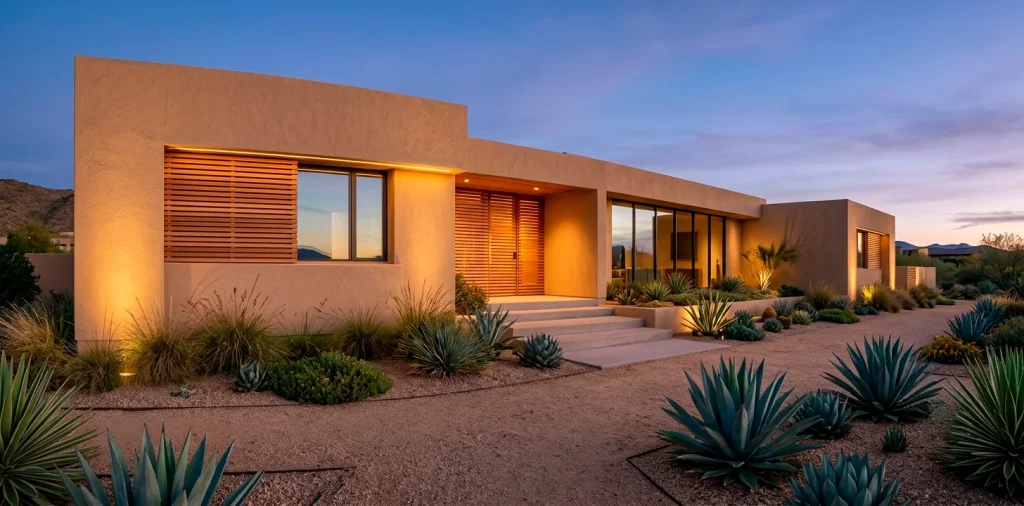

Desert modern exteriors completely changed how I look at curb appeal. Forget those cookie-cutter suburban boxes. We want homes that actually feel alive, blending directly into the landscape with rugged elegance. Warm stucco paired with slatted wood is the absolute cheat code for this aesthetic. Ready to transform your facade? Let me show you how it works.
The DNA of Desert Modernism
Ever wondered why some homes look like they grew straight out of the earth? That is desert modernism in a nutshell. It relies heavily on organic textures and earthy palettes.
You basically want your house to mimic the natural landscape. Warm stucco provides that baked-earth solidity, while slatted wood introduces organic warmth and linear structure. I remember seeing this combo for the first time in Palm Springs and just standing there taking notes. It immediately makes a house look custom and highly intentional. 🌵

Why Warm Stucco Brings the Magic
Bright white stucco looks completely sterile. It blinds you in the afternoon sun.
Instead, we use warm, sandy tones. Think limestone, beige, or soft terracotta. These colors absorb light beautifully and hide dust. Because honestly, who has time to power-wash their house every week?
Texture matters immensely here.
If you want a facade that ages gracefully, ditch the flat finishes. A heavy trowel finish catches shadows as the sun moves across the sky. Shadows are free architecture. You instantly gain depth without adding a single extra material to the facade.

The Slatted Wood Revolution
Slatted wood acts as the perfect counterbalance to heavy, solid stucco walls. It breaks up those massive monolithic surfaces with beautiful, rhythmic lines. Plus, the gaps between the slats allow air to flow, which is a massive bonus for privacy screens or outdoor shower enclosures. I absolutely love using western red cedar or thermally modified ash for these sections. They handle extreme weather like a champ and silver out gorgeously over time if you let them. Want modern curb appeal? Just slap some vertical slats next to your entryway and watch the magic happen. 😉

Balancing the Visual Weight
You cannot just throw wood and stucco together and pray for the best. Balance is everything.
If you cover 90% of the house in wood, it looks like a giant sauna. Cover it entirely in stucco, and it feels like a fortress. IMO, the golden ratio sits around 70% stucco and 30% wood accents. This keeps the masonry as the grounded base.
Use the wood strategically to highlight architectural features. Frame the main entryway, wrap a cantilevered roof, or screen a second-story balcony. Contrast drives the design. Let the stucco play rhythm guitar while the slatted wood shreds the solo.

Picking the Perfect Wood Stain
FYI, choosing a stain practically dictates the entire vibe of your exterior. Go too dark, and you lose the organic desert feel; go too yellow, and you suddenly live in a 90s cabin.
I always recommend transparent or semi-transparent stains in teak, natural cedar, or light walnut. These shades enhance the natural grain instead of suffocating it under a thick layer of pigment. Also, ensure your stain has serious UV protection. Sun damage shows zero mercy to unprotected timber. Need a quick cheat sheet for undertones?
Stain combination ideas:
- Terracotta stucco with cool walnut wood
- Cream stucco with warm cedar slats
- Taupe stucco with ebony-stained ash

Illuminating the Textures at Night
Outdoor lighting completely transforms this material pairing after sunset. If you just slap a bright floodlight on the wall, you ruin the mood entirely. Instead, use warm LED up-lighting positioned directly at the base of your stucco walls and wood screens. The light grazes the textured surfaces, emphasizing every trowel mark and wood grain. I installed brass well lights at my last project, and the nighttime glow made the house look like a luxury resort. Keep the color temperature around 2700K for that perfect, inviting campfire warmth. 🏕️

Avoiding the “Strip Mall” Look
We have all seen it.
A developer tries the desert modern look but ends up creating a building that resembles a generic fast-food joint. The culprit? Cheap materials and zero depth.
To avoid this tragedy, recess your slatted wood elements. Flush transitions look incredibly flat and artificial. Set the wood screens a few inches back from the stucco face.
This creates structural shadow lines. It tells the eye that these are real, thick materials, not just a thin veneer glued to a box. Pay attention to those transition joints, because they make or break the premium aesthetic.

Faux Wood vs. Real Timber
Let us address the elephant in the room: real wood requires maintenance. Depending on your climate, you might need to re-seal those beautiful cedar slats every two years. If that sounds like absolute torture, composite or aluminum alternatives exist.
Modern aluminum battens wrapped in wood-grain finishes look shockingly realistic nowadays. They never warp, fade, or invite termites to dinner. However, purists will always argue that nothing beats the smell and authentic variation of real timber. I personally prefer real wood for high-touch areas like porches, but aluminum works wonders for inaccessible second-story features.

Landscaping Around the Vibe
Your exterior materials desperately need the right plants to ground them in reality. A perfectly manicured green lawn looks completely alien next to desert modern architecture.
Embrace xeriscaping. Use decomposed granite, large agave plants, and sculptural boulders. The spiky, aggressive textures of desert flora contrast beautifully with the smooth, warm stucco and linear wood slats. It just makes sense.
I love framing entryways with tall, slender cacti or ornamental grasses that catch the breeze. These organic shapes soften the harsh geometric lines of modern homes. Need some natural screening? Check out these fast-growing privacy trees.

Bringing It to the Back Porch
Do not let the curb appeal have all the fun. Carrying this stucco and slatted wood combo into your backyard creates a seamless indoor-outdoor living experience. A slatted pergola over a textured stucco patio wall provides incredible dappled shade for afternoon lounging. I highly recommend wrapping your outdoor kitchen island in the same wood battens used on the front facade. It ties the whole property together perfectly. If you want more inspiration for upgrading your rear exterior, explore these quiet luxury back porch ideas.

Conclusion
Nailing a desert modern exterior comes down to balancing earthy textures with clean lines. Warm stucco gives you that grounded, substantial base, while slatted wood delivers rhythm and organic beauty. It completely elevates standard architecture into something extraordinary. Which material are you incorporating first? Let me know in the comments below! 🔥
Related posts
See AllStyling Macramé and Rattan for an Authentic Boho Balcony
Transform your boring balcony into an authentic bohemian oasis using the magic of macramé and rattan. Get practical styling tips, …
Read moreCapturing the Coastal Grandmother Essence: 10 Wedding Ideas
Ready to channel your inner Nancy Meyers for your big day? Discover 10 breezy, elegant Coastal Grandmother wedding ideas that …
Read more15 Matte Black and Cedar Porch Ideas for a Striking Modern Farmhouse Facade
Give your modern farmhouse facade a serious upgrade. Discover 15 striking matte black and warm cedar porch ideas to instantly …
Read more15 Sleek Concrete Mini Pond Ideas for an Industrial Chic Patio
Upgrade your patio with these edgy, modern concrete mini pond ideas. From fire-and-water bowls to brutalist troughs, discover how to …
Read more